

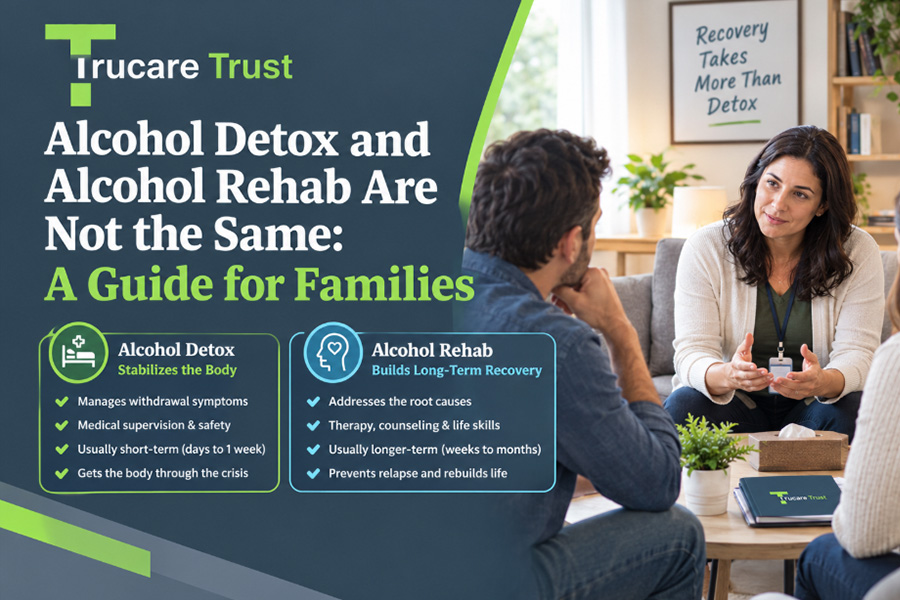
When a family says someone “needs detox”, they may be talking about three separate problems. The person might be physically dependent on alcohol, unable to control drinking or struggling with the relationships and routines built around it. One short hospital stay cannot automatically solve all three. Equally, counselling alone cannot make dangerous alcohol withdrawal safe. Understanding the difference between withdrawal management and rehabilitation helps families avoid a common and sometimes risky mistake: choosing a setting because of its name rather than the care it can actually provide.
The medical stage has one immediate purpose
Alcohol withdrawal can begin when a dependent person reduces or stops drinking. Symptoms vary, but may include tremors, sweating, anxiety, vomiting, a racing pulse and sleep disturbance. More severe cases can involve seizures or delirium, with confusion and major changes in awareness. These are medical risks, not proof that someone lacks determination. The severity cannot be predicted simply by asking how many drinks the person has on an average evening.
A clinician will consider past withdrawals, other illnesses, medicines, nutrition, current symptoms and drinking history. Some people can receive monitored treatment without being admitted to hospital; others need inpatient medical care. Families should not improvise a withdrawal plan, give someone else’s medication or assume that a quiet room and plenty of water will be enough.
Rehabilitation begins where the immediate crisis ends
Once medical stability is established, a different set of questions becomes important. Why does the person return to drinking when they have promised to stop? What happens after payday, during arguments or when they cannot sleep? How will they manage a wedding, client dinner or lonely evening without repeating the old routine? Rehabilitation looks at these patterns through psychological and social support, and may include medicines prescribed by an appropriately qualified clinician.
The two stages may be coordinated, but they should not be confused. Completing withdrawal management does not necessarily mean that cravings, habits or risks have disappeared. A person can look physically better and still need substantial follow-up care. Conversely, not everyone with an alcohol problem needs residential admission; the appropriate setting follows an assessment.
What should happen after the first few sober days?
Early recovery is not always comfortable. Sleep may remain disturbed. A person may be irritable, embarrassed, physically tired or strangely confident that the problem has been solved. Family members who have spent months in crisis may expect immediate gratitude and a complete personality change. That expectation often produces another round of conflict.
Good care gives room for both practical and psychological work: understanding the pattern of use, identifying situations that make drinking likely, developing alternatives and preparing relatives for setbacks. A daily routine can help, but activities alone should not be presented as the treatment. Ask how progress is reviewed and what qualified staff do when the original plan does not fit.
Families reviewing True Humaniversity Foundation’s residential rehabilitation approach can ask how individual care plans work. The answer should explain how an individual care plan is built and how the family learns to support recovery without managing every decision. A provider’s proximity to Mumbai or Thane matters for family visits, but safe clinical pathways matter much more in the first days.
Beware of a fixed timetable sold as a cure
Alcohol-related problems differ in severity, duration and accompanying health conditions. A predetermined number of days may be part of a programme’s administration, but it does not prove that every person will be ready for the same level of independence on the same date. Medical stabilisation, counselling, family work and continuing support each operate on different timelines.
Families comparing alcohol rehab and residential support through Trucare Trust should ask who decides whether hospital withdrawal care is needed before admission. Ask where the person would be referred if severe withdrawal occurs, whether a medical assessment is documented and how rehabilitation continues after physical symptoms settle. A responsible answer will recognise the limits of the facility as well as its strengths.
One practical distinction is worth making before the family leaves a medical appointment. Ask whether the clinician is treating withdrawal symptoms, prescribing ongoing treatment for alcohol dependence, arranging talking therapy or recommending all of these at different stages. A medicine used during the withdrawal period is not necessarily a medicine intended for long-term relapse prevention, and neither should be started, shared or stopped based on advice from friends. Families also need to know what changes require urgent reassessment after returning home. Keep discharge instructions where they can be found, confirm the next appointment and make sure the person receiving care understands the plan in ordinary language rather than technical terms alone.
Preparing the home matters too
Before discharge, conversations should move beyond “Will you promise never to drink again?” Families need to discuss the first weekend home, access to money, invitations involving alcohol, prescribed medicines, follow-up appointments and how to respond if the person feels close to drinking. A written plan may include warning signs, supportive contacts and a clear route back to professional care.
There is also work for relatives. Constant surveillance can damage trust and increase tension, yet pretending nothing happened is rarely sustainable. Families can agree on respectful communication and boundaries, recognise their own exhaustion and avoid treating a single difficult day as evidence that all treatment has failed.
Alcohol withdrawal management protects health during a potentially dangerous change. Rehabilitation deals with the longer task of living differently. Neither should be advertised as a universal cure, and neither should be chosen without understanding what the person needs now. The most helpful question a family can ask is simple: what problem is this part of treatment meant to solve, and what comes next?