

HEALTHCARE ADVERTISING GUIDE
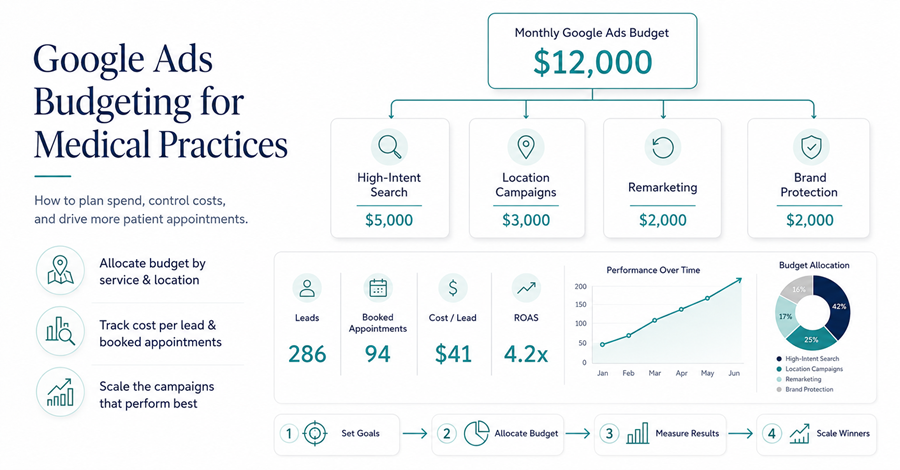
Medical practices often choose a Google Ads budget by copying a competitor, accepting a platform recommendation, or dividing money evenly across locations. None of those methods connects spending to the economics of the practice.
A practical medical advertising budget should begin with patient value, conversion rates, available capacity, and the cost of generating a booked appointment. The objective is not to spend the same amount everywhere. It is to fund the services and locations that can turn demand into profitable patient growth.
This guide explains how to build a budget, split it across campaigns, and adjust it without reacting to every week of normal performance variation.
What This Post Covers
- Calculating allowable acquisition cost
- Estimating a useful starting budget
- Splitting spend by service and location
- Accounting for capacity and lead handling
- Using impression share and marginal cost
- Making budget changes gradually
1. Begin With Patient Economics
Budgeting should start with the value of a new patient, not the cost per click. Estimate the revenue or contribution generated during a realistic period, then account for the percentage of leads that schedule, arrive, and continue treatment.
A surgical consultation, diagnostic test, therapy plan, and routine visit have different economics. Use separate estimates by service line instead of one practice-wide average that hides those differences.
Perfection is not required. A directionally accurate estimate is more useful than having no number at all. Finance, operations, and marketing should agree on the assumptions before the campaign launches.
Question to Answer: What is a new patient worth by service line during the first year?
2. Calculate the Maximum Acceptable Acquisition Cost
The allowable cost per new patient should leave room for clinical delivery, staff, overhead, and profit. It should also reflect the percentage of leads that never become patients.
If a booked patient is worth $1,500 in contribution and the practice is comfortable investing 20 percent in acquisition, the maximum cost may be about $300. If only half of qualified leads become booked patients, the allowable cost per qualified lead is roughly $150.
Use these numbers as guardrails rather than promises. Actual targets should account for cash flow, growth stage, retention, and the strategic value of filling underused capacity.
Question to Answer: What is the highest cost per booked patient the practice can accept profitably?
3. Estimate the Minimum Budget Needed for Data
A campaign cannot learn from traffic it never receives. Very small budgets spread across many services produce a few clicks in each campaign and unstable results.
Estimate the likely cost per click, landing-page conversion rate, and lead-to-patient rate. Use those assumptions to calculate how much spend is required to generate a meaningful number of leads and booked appointments.
When the available budget is limited, prioritize one or two services instead of creating a campaign for every department. A focused campaign can generate enough data to improve; five underfunded campaigns cannot.
Question to Answer: Does each campaign have enough budget to generate several qualified leads per month?
4. Split Budget by Strategic Priority and Capacity
Patient value is not the only consideration. A profitable service should not receive more advertising if the schedule is full, the required provider is unavailable, or the location cannot answer additional calls.
Create a monthly capacity view by service and location. Include open appointment slots, provider availability, intake staffing, and any seasonal limitations. Shift spend toward the areas that can accept patients now.
This prevents marketing from generating demand the practice cannot serve. It also makes budget conversations more objective because spending is tied to actual operational capacity.
Question to Answer: Which services and locations can accept the next ten patients without creating delays?
5. Protect Branded and High-Intent Demand
Branded campaigns usually require a relatively small budget, but they should not be allowed to disappear because another campaign consumed all available spend. Protect brand searches, urgent services, and other high-intent categories that consistently produce patients.
High-value campaigns also need dedicated budgets when their click costs are substantially higher. Otherwise, lower-cost general searches can absorb the daily budget before procedure-specific demand enters the auction.
Budget protection does not mean unlimited spending. It means giving strategically important demand a fair opportunity to compete.
Question to Answer: Are the most valuable searches losing visibility because cheaper campaigns spend first?
6. Use Impression Share as a Diagnostic, Not a Goal
Impression share can show whether a campaign is missing eligible searches because of budget or rank. It does not automatically mean the practice should spend more.
Increase budget when the campaign has a healthy cost per booked patient, sufficient capacity, and lost impression share caused by budget. If performance is weak, additional spend usually magnifies the problem.
Also review impression share by service and time of day. A campaign may appear adequately funded overall while losing visibility during the hours when the front desk is available to answer calls.
Question to Answer: Is the campaign budget-limited while still producing patients below the allowable acquisition cost?
7. Account for the Cost of Missed Leads
Advertising budgets are often reviewed without considering operational leakage. If the practice misses 30 percent of calls, the effective acquisition cost is much higher than the Google Ads report suggests.
Measure answer rate, speed to lead, booking rate, show rate, and intake capacity alongside media spend. Improving these numbers can create more patients without buying another click.
Before increasing budget, confirm that leads receive a timely response and that appointments are available. The cheapest growth opportunity may be fixing the phone process.
Question to Answer: How much advertising spend is currently lost to unanswered or poorly handled leads?
8. Adjust Budgets Gradually
Large budget changes can create unstable delivery and make it difficult to understand what caused a performance shift. Make deliberate adjustments, document the reason, and allow enough time for the result to become visible.
For established campaigns, changes of roughly 10 to 20 percent are often easier to evaluate than sudden doubling or cutting. Larger changes may be necessary when capacity, policy, or business priorities change, but they should be treated as a new test.
Review budgets monthly for strategic allocation and weekly for clear operational issues. Avoid moving money every time one campaign has a bad day.
Question to Answer: Are budget decisions based on a repeatable review process or short-term reactions?
9. Report Cost Per Booked and Completed Patient
Cost per lead is useful, but it is not enough for budget allocation. Two campaigns can have the same lead cost and completely different booking and show rates.
Report spend, qualified leads, booked appointments, completed visits, and estimated patient value by campaign. This makes it possible to identify campaigns that generate inexpensive but low-quality inquiries.
When revenue attribution is difficult, use agreed patient-value estimates. Consistency matters more than false precision.
Question to Answer: Which campaign produces the lowest cost per completed new-patient visit?
In Summary
Healthcare Google Ads budgets should follow patient economics and operational capacity. Calculate an allowable acquisition cost, fund campaigns enough to produce data, and protect services with strong intent and value.
Do not divide spend evenly for the sake of fairness. Move budget toward campaigns that produce booked patients profitably and toward locations that can serve them.
The best budget is not the largest one. It is the amount the practice can convert into measurable patient growth without overwhelming the intake process.